
Discover the top digital marketing trends for 2026 that are actually shaping real strategies, no buzzwords, just clear shifts in AI, search, video, data, and growth.
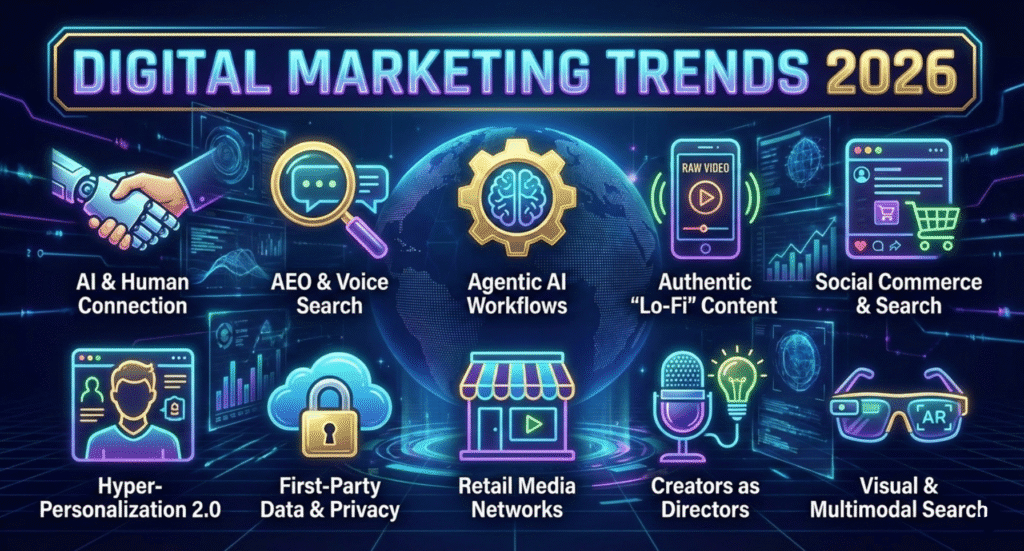
Over the last few years, marketers have been busy testing various things. AI content. Cookie-less tracking. Shoppable videos. Retail media networks. Cool ideas everywhere. Lots of experiments. Some worked. Many didn’t.
Now, as we move into 2026, the question isn’t “Can we do this?”
It’s much sharper.
“Are we doing it properly?”
That shift alone defines the next phase of digital marketing trends. Execution matters more than excitement. Strategy matters more than hacks. And issues of integration, more than individual channels.
Let’s take a look at the top 10 digital marketing trends of 2026 that no brand, agency, or marketer should miss. Marketers use trends to caption their posts and give meaning to various features.
Actually, trends relate to people and people’s behaviors.
1. Conversational Search Redefines SEO in Digital Marketing Trends
Search doesn’t look the same anymore.
People don’t type keywords. They ask questions.
Sometimes they speak. Sometimes they chat with AI. Sometimes they don’t even click anything. Answers appear instantly, right inside the platform.
This is highly coupled with AI-driven search experiences that have been introduced by platforms like Google, which increasingly provide direct answers to users rather than results themselves.
This is why traditional SEO thinking is under pressure. Visibility is no longer about ranking pages only. It’s about being the answer, wherever the question is asked.
For SEO professionals, the work shifts toward intent-based content, structured data, FAQs, schema markup, and content designed for voice and AI-generated responses. Zero-click searches will increase. That’s the reality.
Takeaway: Optimize for conversations, not keywords alone. Measure beyond clicks – brand recall, visibility, and presence in AI answers now matter.
2. The Video-Commerce Boom
Video used to be about engagement, Likes, Views, Shares, but not anymore.
Short videos, live streams, interactive formats – everything is moving closer to direct buying. Social platforms are actively pushing checkout inside video experiences.
This means brands must rethink their video strategy. Storytelling still matters, yes. But now every video can also be a sales moment. Product tags. Live shopping. Click-to-buy overlays.
And measurement? Views alone won’t cut it.
Takeaway: Treat video as a full-funnel asset. Build it with purchase actions in mind, not just awareness.
3. The Privacy-First Data Revolution
Third-party cookies are fading. Regulations are tighter. And users are more aware than ever.
According to a study by EMARKETER, industry research shows that brands are rapidly shifting toward first-party data as privacy regulations are seriously tightened worldwide.
This forces brands to look inward.
Your first-party data – emails, app behavior, purchase history, consent-based tracking – becomes the foundation. Without it, targeting weakens. Measurement breaks. Optimization slows down.
Smart brands are building strong data systems: customer data platforms, conversion APIs, and unified online-offline tracking.
Takeaway: Make first-party data and measurement architecture a foundational pillar of your 2026 strategy. Without it, media investment and optimization will degrade rapidly.
4. Retail Media Networks Go Mainstream
Retail media networks were once experimental. Not anymore.
They combine rich purchase data with high-intent audiences. That’s powerful. Very powerful. Brands can see direct impact at the SKU level – something rare in digital advertising.
Ignoring RMNs in 2026 is risky. Treating them as “just display ads” is even riskier.
Takeaway: Begin crafting your RMN strategy immediately. Integrate product information, media planning, and measurement functions. Also, collaborate with e-commerce and pricing colleagues to deliver tangible returns.
5. The Creator Economy Evolves Into Co-Creation
Influencer marketing is growing.
Posting once and getting paid won’t deliver the same results in 2026. The shift is toward co-creation. Creators help design products. Shape campaigns. Build communities.
Audiences can feel the difference. Authentic partnerships perform better. Always have.
Takeaway: Paradigm from “influencer as amplifier” to “creator as partner.” They should be immersed in product development, marketing output, and evaluation cycles, and made co-owners of the brand experience.
6. Community + Authenticity = The New Brand Moat
People don’t just buy brands anymore. They join them.
Communities — forums, private groups, apps, owned platforms – become key engagement drivers. At the same time, audiences expect honesty. Real voices. Real values.
Employees. Founders. Customers. All matter.
Takeaway: Develop and foster community; amplify internal voices; quantify authenticity via metrics such as engagement, member retention, and referral-not just “brand good feeling.”
7. AI As The Strategic Operating System
AI is no longer just a content tool.
In 2026, it runs analytics, media buying, optimization, workflows, and personalization. Humans still lead strategy, but AI executes at scale.
For SEO professionals, digital marketers, and content writers alike, the decision is no longer “Should we use AI?” but rather “How do we govern, integrate, and scale AI across planning, creative, measurement, and optimization?” It means human-in-the-loop becomes essential: humans set strategy, guard for bias, ensure brand safety, while AI executes at scale.
Takeaway: Treat AI like infrastructure, not an experiment. Human oversight stays critical.
8. Relearning ROI Through Marketing Mix Modeling
Traditional attribution models are breaking down. Too many platforms. Too much privacy. Too many blind spots.
Marketing mix modeling (MMM) is making a comeback. It looks at the big picture. Spend. Impact. Revenue. Incremental lift.
This helps brands speak the language of business again.
Takeaway: Build robust MMM infrastructure. Get media teams closer to finance and analytics folks, and measure performance in real business outcomes—incremental lift and ROI, to name a couple—versus more superficial metrics.
9. Immersive Experiences And Gamification Redefine Engagement
It seems that lines separating entertainment, engagement, and commerce continue to blur with each passing year. Augmented Reality, Virtual Reality experiences, and even gamified marketing campaigns take marketers far away from traditional advertising structures that do little more than create brand awareness.
A report from the 2025 Digital Media Trends study of Deloitte Insights highlights that hyperscale social video offerings are redefining viewer behavior and tilting significantly from passive to interactive.
Brands: Simply presenting an image of a product for click-through isn’t enough anymore. Effective immersive experience programs would require real-world utility (e.g., AR product tries, gamified launches, metaverse visits) along with robust measurement infrastructure (engagement to store visit to sales).
Takeaway: Use immersive formats strategically. Tie them to measurable actions and outcomes.
10. The Human Edge: Upskilling For An AI Era
When you look closely, one thing sits behind all these trends. The team. Technology moves fast. Culture and people evolve. In the year 2026, the companies that will start pulling in front are the companies that are going to invest in skills, hybrid talent, and speed of decisions around data, creative, and media.
For instance, a recent research from McKinsey & Company illustrates the gap. Most companies are optimistic about increasing investment in AI, but very few companies have implemented AI in a manner that aids in achieving business outcomes.
“That’s the true mandate going into 2026. The key to marketing competence in this new landscape is to build marketing capabilities centered on three fundamentals: deep data literacy, productive AI literacy, or strong media, product, commerce, and community connect capabilities,” Bressler said. “Otherwise, strategies that play well in the presentation room can fall apart in practice.”
Skills. Culture. Speed of learning.
Takeaway: Place upskilling, talent, and culture on an equal footing to technology and media. Build a team that can move at pace, learn continuously, and collaborate across functions.
Final Thoughts: Digital Marketing in 2026 Is About Integration
However, what binds these trends together? Two words: Integrated Authority.
In the year 2026, the marketer’s job must evolve from considering individual channels or silos to more integrated systems that provide a single experience.
With the increasing complexity of digital marketing in 2026, brands are expected to think in new ways about the role of visibility in a particular region as well as on any particular platform. For a more in-depth analysis on what this means, our SEO vs. GEO guide breaks down what’s changing in search strategies.
On the other hand, authority must be earned, whether through first-party data, trusted communities, content partnerships, or business outcomes.
As you plan and execute your 2026 marketing strategy:
- Treat media as a conduit to business outcomes (not just impressions).
- Treat data as capital (not just input).
- Treat AI as an engine (not just an experiment).
- Treat measurement as proof (not just dashboard).
- Treat talent and culture as differentiation (not just overhead).
Those who excel in this art will not only keep up, but they will also lead the next shift within the digital marketing spectrum. What matters isn’t whether you implement each of the following trends, but how you integrate each into your business.
Thus, here’s to 2026, where strategy meets execution, where complexity meets clarity, and where digital marketing meets true business-driven processes.
nice information in 2026 digital marketing trends