
A clear look at SEO vs GEO, the persistence of continuity messaging, changing consumer behavior, and why clicks no longer tell the complete visibility story.
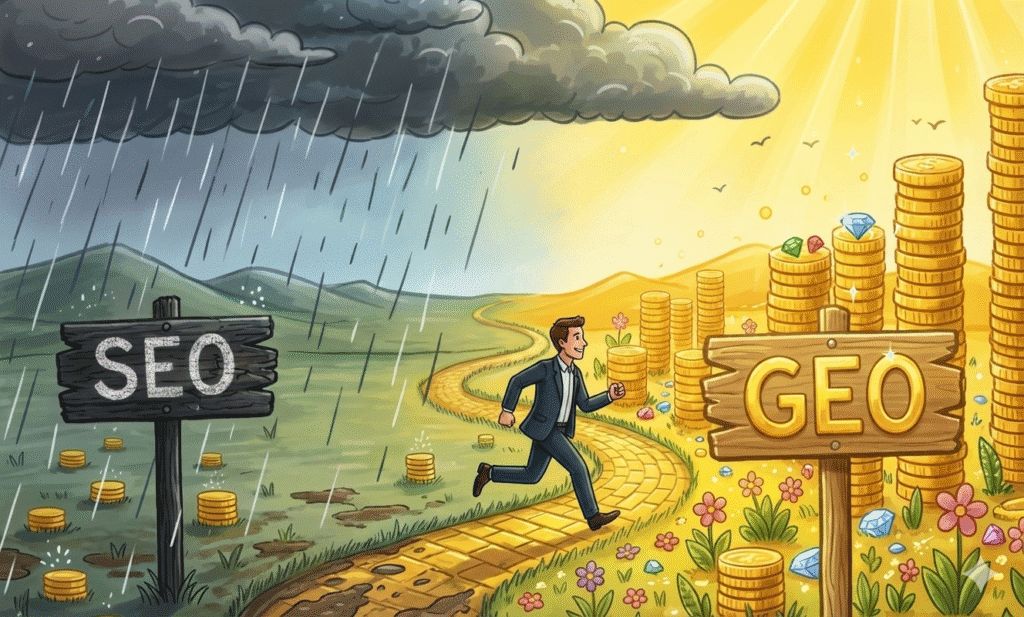
The search industry is moving through a quiet but meaningful transformation. While public messaging continues to suggest that the fundamentals of search optimization remain unchanged, user behavior and modern discovery systems indicate otherwise. Businesses are told that traditional SEO still covers everything that matters, yet the way information is retrieved, summarized, and trusted is shifting rapidly.
This disconnect raises an important question: who actually benefits when the difference between SEO vs GEO is not clearly defined?
To understand how search fits into the broader digital ecosystem, it’s important to first look at what digital marketing actually involves.
This discussion is not about assigning blame or targeting specific platforms. Instead, it is about understanding why continuity messaging persists, how consumer behavior is evolving, and what businesses risk missing as search becomes increasingly answer-driven.
The Shift From Click-Based Search to Answer-Driven Discovery
Search behavior today looks very different from even a few years ago. A growing number of users rely on AI-generated summaries to get quick, direct answers. As these summaries appear more frequently, users often find what they need without clicking through to a website.
Studies across the industry consistently show the same pattern: when AI summaries are present, click-through rates on traditional organic results decline. Informational queries are the most affected, as users trust the synthesized answer shown directly on the results page.
This change does not mean that the content has lost value. Instead, it signals that visibility is no longer measured only by clicks. Information can influence decisions even when the user never visits the source page.
Why Continuity Messaging Persists
Despite clear signals of change, much of the industry continues to frame SEO vs GEO as essentially the same practice. This messaging is not accidental; it is largely driven by incentives.
Large platforms benefit from stability. Encouraging businesses to keep optimizing content using familiar SEO frameworks ensures a predictable flow of structured information that supports existing systems. Clear distinctions would require new measurement models and greater transparency around how answer layers affect visibility.
Agencies and consultants also benefit when the line remains blurred. When GEO is treated as an extension of SEO rather than a separate discipline, existing strategies can be reused with minimal operational change. This reduces the need for rapid retraining or major shifts in service offerings.
Tool providers tied to traditional SEO metrics face similar incentives. If SEO vs GEO is framed as the same challenge under a new name, investment in retrieval-focused analytics, answer attribution, and cross-engine tracking can be delayed.
Where SEO and GEO Overlap
It is important to be clear: SEO still matters.
Strong technical foundations, clear writing, structured data, and authority signals remain essential. Content that is thin, outdated, or inaccessible will struggle in both traditional search and AI-driven answer environments. These shared fundamentals form the overlap between SEO and GEO.
However, overlap does not mean equivalence.
Where SEO and GEO Begin to Diverge
The real difference between SEO vs GEO lies in how visibility is earned.
SEO focuses on pages, rankings, and click-through performance. The goal is to attract visits by appearing prominently in search results.
GEO, or Generative Engine Optimization, focuses on how information is retrieved, interpreted, and reused within AI-generated answers. The goal is presence, even when no click occurs.
Modern answer engines do not treat a webpage as a single unit. They extract specific sections, blend them with other sources, and present condensed responses. Sometimes sources are cited clearly. Other times, brand influence appears without direct attribution.
In this environment, content must be structured in clear, self-contained blocks. Entity relationships, definitions, and actions need to be easy for systems to interpret. Visibility must be tracked beyond traditional metrics like impressions and clicks.
Changing Consumer Behavior Confirms the Trend
Consumer adoption of generative AI tools has accelerated rapidly. What began as experimentation is now part of everyday information-seeking behavior. Users increasingly rely on AI systems to explain topics, summarize complex ideas, and guide decisions.
As trust in these systems grows, the role of the webpage changes. Pages still matter as sources, but users may never see them. What matters more is whether the information can be accurately retrieved and confidently presented by the system.
This shift reinforces why SEO vs GEO should not be treated as interchangeable concepts.
Why Traffic Alone No Longer Reflects Influence
For years, traffic has been treated as the primary indicator of success. In an answer-driven environment, that assumption no longer holds.
A platform may deliver minimal referral traffic while still shaping user understanding and decision-making at scale. Influence can exist without visits. Metrics such as adoption, frequency of use, and task reliance provide better insight into where attention is actually forming.
Businesses that rely only on click-based reporting risk underestimating their real exposure or missing declines in visibility that traditional analytics cannot capture.
Who Truly Benefits From a Blurred Line?
When the distinction between SEO vs GEO remains unclear, established systems benefit from continuity. Platforms gain predictability. Agencies maintain familiar workflows. Tool providers delay costly transitions.
The cost is absorbed by businesses. They continue optimizing for rankings while visibility shifts into answer layers that they cannot clearly measure. Performance appears stable, yet influence gradually erodes.
Clear definitions change this dynamic. Understanding where SEO ends and GEO begins allows organizations to align strategy with how search actually works today.
Clarity Is the Real Competitive Advantage
The rise of answer-driven discovery does not replace SEO. It builds on it. But it also demands new thinking, new metrics, and new skills.
Businesses that recognize the difference between ranking-focused SEO and answer-focused GEO are better positioned to maintain visibility across modern search environments. Those who rely solely on continuity messaging risk falling behind without realizing it.
Recent updates across AI-driven platforms further reinforce how quickly discovery models are shifting away from traditional, click-based search.
The work is changing. The signals are shifting. And clarity, not comfort, is what will define long-term success in the SEO vs GEO era.